You've worked together, but have you ever faced a dragon together?
Cohort Quest is a facilitated team experience for workplaces.Your group navigates a shared story that we create together in real-time. You will face challenges that provide opportunities to practice communication, cooperation, improvisation, flexible thinking, and confidence in a setting that feels playful and low-pressure.

Why Cohort Quest?
Traditional team-building tools can be valuable, but they often focus on one kind of challenge at a time. Cohort Quest brings people into one cooperative experience where they get to make decisions, help one another, recover when the plan goes sideways, and have a genuinely good time doing it.
| Traditional Tools | Cohort Quest |
|---|---|
| Icebreakers get people talking, but they can feel forced or awkward. | As a Cohort Quest story unfolds, conversation happens naturally: teammates make plans, take chances, solve problems, and cheer each other on. |
| Team-building exercises can create a fun moment. | Cohort Quest creates “Remember when we…” moments, inside jokes, unexpected heroes, and a team memory that lingers. |
| Strengths assessments can give people useful language for patterns and preferences. | Cohort Quest lets people try on new roles. Someone who is usually quiet may make the big call. Someone who usually leads may discover the value of stepping back. Individuals can be themselves, rise to the occasion, and see how they can help their cohort so that everyone wins the day, together. |
| Escape rooms are fun, but usually come down to puzzles, a clock, and whether the team gets out in time. | There is no single correct answer. Your team has to decide what matters, adapt when the plan goes sideways, and deal with the consequences. |
| Obstacle courses and physical challenges can be a blast... for the people who enjoy competition or being active. | There's no running or jumping in Cohort Quest, except in the story. But there is plenty of cooperation and many challenges to overcome. Everyone has a different way to help the group: noticing the detail everyone else missed, talking their way past a problem, keeping the plan on track, taking the risk when the moment calls for it, or making sure no one gets left behind. |
How does it work?
I’ll begin by welcoming everyone and explaining the format. Each person creates a Cohort Quest character with four simple Traits: Strong, Fast, Smart, and Social - choosing which of these their character is most and least skilled in.For groups larger than about 15 people, participants divide into smaller teams. Each team creates one character together, then guides that character through the story as a group.Once the characters are ready, I set the scene and begin the adventure. When the story presents a challenge, participants decide what they want their character to do, choose the Trait that best fits the moment, and roll a die (adding the respective Trait’s bonus) to see how the world responds. A roll might mean the plan works beautifully, works with an unexpected complication, or sends the group in a new direction entirely.
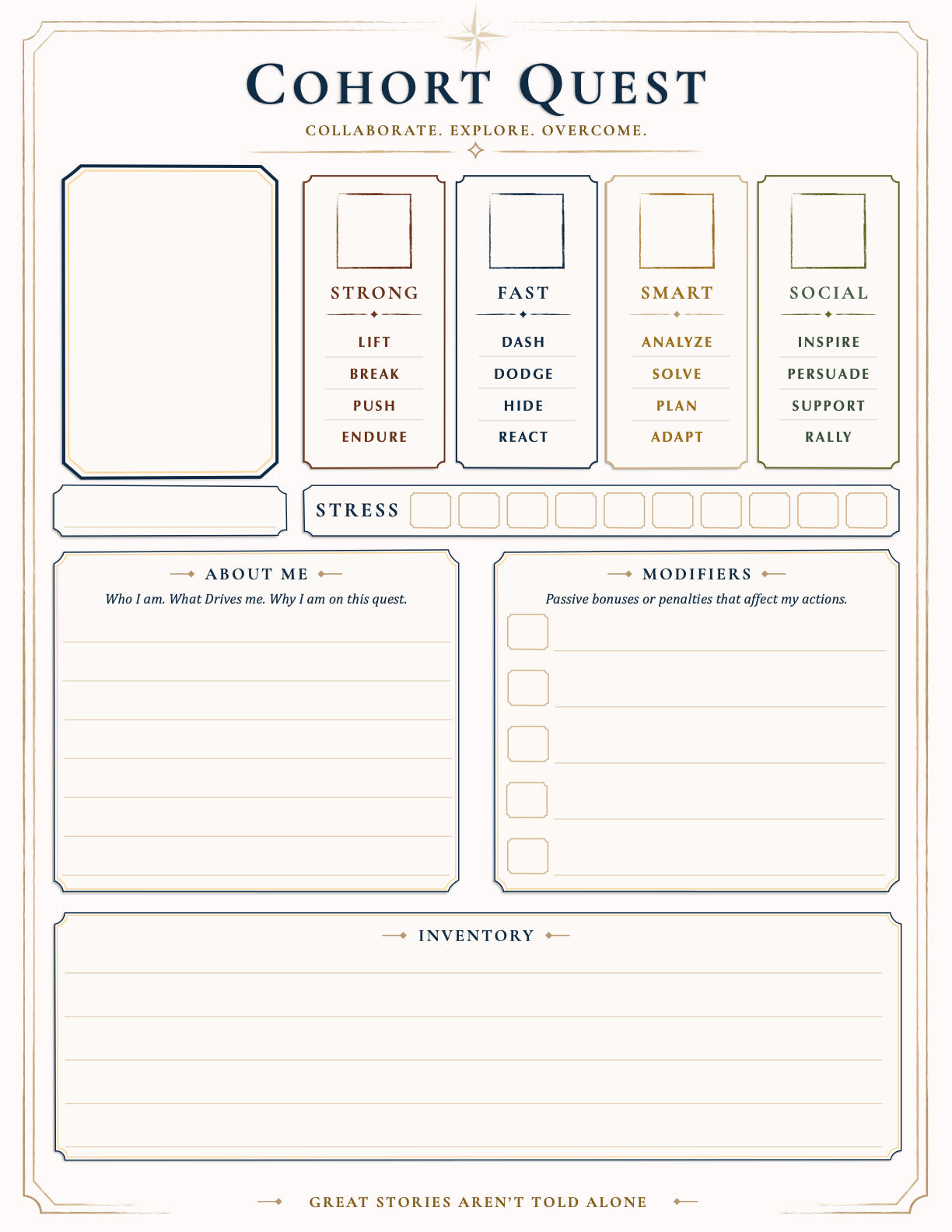
Simple Mechanics. Endless Stories.
Traits

Your character is defined by four core Traits. Choose the one that best fits what you're trying to accomplish.
Stress

Gain Stress as a natural consequence, or when you push yourself to Help your Cohort.

How Your Team Adventures
Collaborate
Before our in-person session, we clarify your goals and design a scenario that reflects your team's strengths and styles. At the start of the session, I work with your team to build a world and their characters.
Explore
Your cohort navigates the story together, making decisions, rolling dice, and seeing how different approaches shape the outcome.
Overcome
Face challenges that test your team's creativity, encourage teamwork and communication, and spark creative problem‑solving. Roleplay situations that provide perspective, build compassion, and let social and emotional skills develop naturally through play.
Pricing & Details
Duration: 90-minute Intro, 3-hour Standard, or 5-hour Deep DiveGroup size: Small (3-7), Medium (8-15), Large (16-30), or Stage (30+)Format: For Small and Medium sized groups, we gather around a single table. For Large and Stage sizes, participants divide into smaller groups of 3-10 around their own table and create and guide one character as a group. All tables participate in one shared story. This larger Format has its own unique experience and includes additional time for each table to debrief together afterwards.Location: In-person at your Eugene/Springfield location. Travel outside the area is available for an additional fee.Pricing: Most 3-hour Small and Medium Cohort Quest workshops for local teams are $900–$1,200, depending on group size and the level of customization. Shorter introductory sessions and extended deep-dive formats are also available. Large and Stage events are custom-designed and quoted based on staffing, room setup, and production needs.Contact us for a tailored quote.
Let's Start Your Quest
Have a question or want to bring Cohort Quest to your team?

Together, we'll craft your next great story.
Note: These testimonials are from StoryQuest and are included here because they speak to the facilitation and experience behind Cohort Quest.
"My son loved the week-long camp experience. Each day he would come back recounting the day’s trials and challenges that his cooperative team took on, and what they still needed to accomplish. He rarely describes details from camp, but with StoryQuest, he described much more than the basics. He was fully engaged. He even asked if he could do one more week halfway through his camp! I highly recommend it."
-Jon B. (Eugene, OR)
"It was really fun searching for all the keys. I liked drawing the places we explored. I’d rate it 9.99 out of 10!"
- Remy (Eugene, OR)
"My son had a blast creating a world with his peers and working together to solve problems. His enthusiasm for the class stayed high throughout the week. He was ecstatic at the end of the quest when they achieved their goal. He’d definitely do it again."
- Jesse (Eugene, OR)
Let's Start Your Quest
Have a question or want to bring Cohort Quest to your team?

Together, we'll craft your next great story.
Thank you for inquiring.
We’ll respond within 2 business days to schedule a brief consultation and tailor a Cohort Quest for your team.
About the Storyteller

"Aaron is a brilliant and dynamic Storyteller. He creates intriguing and immersive worlds that are thrilling and satisfying to explore and interact with. I’ve played dozens of games across 3 years and have consistently been very happy with his craft!"
- Isaac (Cottage Grove, OR)
Hi, I’m Aaron Madzik (pronounced “magic”), the creator of Cohort Quest. I’ve been designing and running tabletop roleplaying experiences for more than 35 years, starting in 5th grade when I first began leading games for my friends. Over time I’ve explored a wide range of roleplaying systems including Dungeons & Dragons, Traveller, Daggerheart, Blades in the Dark, and Call of Cthulhu. What has always mattered most to me is the shared storytelling, creativity, and improvisation that happens when people collaborate around a table.Teaching and facilitation have been central to my career. After college, I worked at Apple as a Presenter and Business Specialist, training beginners and experienced professionals: business clients, photographers, students, and filmmakers. In 2003 I began working as an independent computer consultant, and in 2011 I founded my own company, Partners in Computing, where I help individuals and organizations use technology more effectively.I also bring extensive experience working with youth and families. As a young adult I served as a camp counselor for a music camp, and from 2009 to 2012 I was Program Leader for Creswell Clubhouse, an elementary after‑school and summer program, later serving as President of its Board. I am a parent of two children and have facilitated many narrative experiences for them and their peers. In addition, I coach youth soccer through Kidsports and volunteer with Rose Children’s Theatre (RCT); my most recent background check with RCT was completed in April 2026. This year I created and ran a Summer Camp for children ages 7-13 called StoryQuest.Cohort Quest grew out of these combined threads: decades of narrative design, a career in teaching and client training, and a commitment to creating environments where people can learn, experiment, and connect. My aim is to offer teams a structured, story‑driven experience that surfaces how they collaborate under pressure, respond to uncertainty and change, and support one another within a safe, low‑stakes setting that is meaningful and memorable.Outside of work, I enjoy spending time with my family and a range of hobbies, including writing music, playing piano, rock climbing, kung fu, disc golf, hiking, backpacking, and cooperative games of all kinds.
Frequently Asked Questions
What is Cohort Quest?
Cohort Quest is a facilitated, tabletop-style experience where your team steps into a shared narrative together. Participants imagine a character, describe what they want to do, and use simple game mechanics when outcomes are uncertain. The focus is on collaborative decision‑making, reflection, and insight.
How does Cohort Quest replace traditional team building exercises?
Cohort Quest replaces disconnected icebreakers and stand-alone activities by giving your group one shared experience that unfolds over time. Instead of doing a quick exercise and moving on, participants work through a story together, which creates a more natural sense of teamwork, shared purpose, and follow-through.Because the group is making choices inside the same narrative, you can see how people collaborate, problem-solve, support one another, and respond when things get difficult. That makes the experience feel less like a game you “did” and more like a meaningful team moment you can actually talk about afterward.It also goes beyond strengths labels by asking a different question: not “What type am I?” but “How did each of us show up when the team needed us?” That shift makes strengths feel less abstract and more relevant to how people work together in real life.Cohort Quest also brings communication into the mix in a way that feels lived, not theoretical. Participants are actively listening, explaining, persuading, checking in, stepping back, and taking the lead as the story unfolds, so communication patterns become visible through action rather than just discussion.
What skills and dynamics does Cohort Quest help surface?
Cohort Quest is designed to highlight and practice:
- Teamwork and collaboration under pressure
- Communication styles and listening
- Creative problem‑solving and adaptability
- Perspective‑taking and empathy
- How individuals respond to stress, uncertainty, and change
What kinds of stories do you create?
Together we define a setting and tone that fits your group. The scenarios are tailored to highlight themes like navigating change, facing uncertainty, balancing competing priorities, or supporting one another under pressure. The goal is not to simulate your workplace literally, but to create a narrative that surfaces relevant dynamics in a fresh, low‑stakes environment.
Is Cohort Quest the same as Dungeons & Dragons?
Cohort Quest is inspired by the collaborative spirit of games like D&D, but it uses a much lighter system designed for non‑gamers and mixed groups. The game mechanics are intentionally streamlined so participants can begin quickly, stay focused on the story, and spend their time interacting with one another rather than learning a rulebook.
Do participants need prior experience with roleplaying games?
No. Cohort Quest is built for mixed groups, including people who have never played a roleplaying game before. The facilitator guides participants step by step, and the mechanics are simple enough to learn as you go. The emphasis is on conversation, choices, and reflection, not on rules mastery.
How do characters work?
Each character uses four simple Traits: Strong, Fast, Smart, and Social. During character creation, participants assign different values to these Traits (+2, +1, +1, 0) to shape the kind of role they want to play. When a character attempts something challenging, they narrate what they are trying to accomplish (their intention), choose the Trait that fits the action, roll a 20-sided die, apply their Trait bonus and any relevant Modifiers, and we resolve the outcome together. This keeps the system intuitive while still giving structure to the story.
What is Stress?
Stress is a simple way to track pressure, setbacks, effort, and risk during the experience. Characters can gain Stress as a natural consequence of the story or when they choose to push themselves to Help their Cohort. As Stress accumulates, it influences how the character is feeling and performing, creating opportunities for support, recalibration, and reflection on how we manage strain in real life. If they fill their Stress bar, they gain a -1 Modifier to their rolls.
What are Modifiers?
Modifiers represent lasting effects from the narrative: bonuses or penalties that arise from what has happened so far. A character might gain a positive Modifier from a successful preparation or a key relationship, or a negative Modifier from an injury, misstep, or unresolved tension. These simple flags help the story leave a meaningful mark on the characters and keep prior decisions relevant.
Is Cohort Quest competitive?
No. Cohort Quest is cooperative. Participants work together to solve problems, face challenges, and build a shared narrative. The “win” is discovering how the group operates, what strengths show up, and how the team can carry those insights back into day‑to‑day work.
What does a Cohort Quest session feel like?
A session typically includes storytelling, character interaction, group decision‑making, light mechanics, and moments of humor, tension, and collaboration. You can think of it as a facilitated story where your team helps decide what happens next and then steps back together to examine what those decisions reveal.